Should you choose an inflatable or foam seat cushion for travel?
Choose an inflatable seat cushion when adjustable air firmness and deflated packing are your priorities. Choose a foam seat cushion when you prefer a ready-to-use shape without pumping or valve adjustment. Neither material is automatically more comfortable: compare the actual cushion’s dimensions, sitting height, packed size, care requirements and fit with the seat you will use.
A material comparison is useful only when it helps you make a decision. “Air” and “foam” describe how a cushion works, but do not tell you whether it fits a narrow seat, feels right beneath you or takes up too much space in your bag. Start with your journey and the trade-offs you can live with.
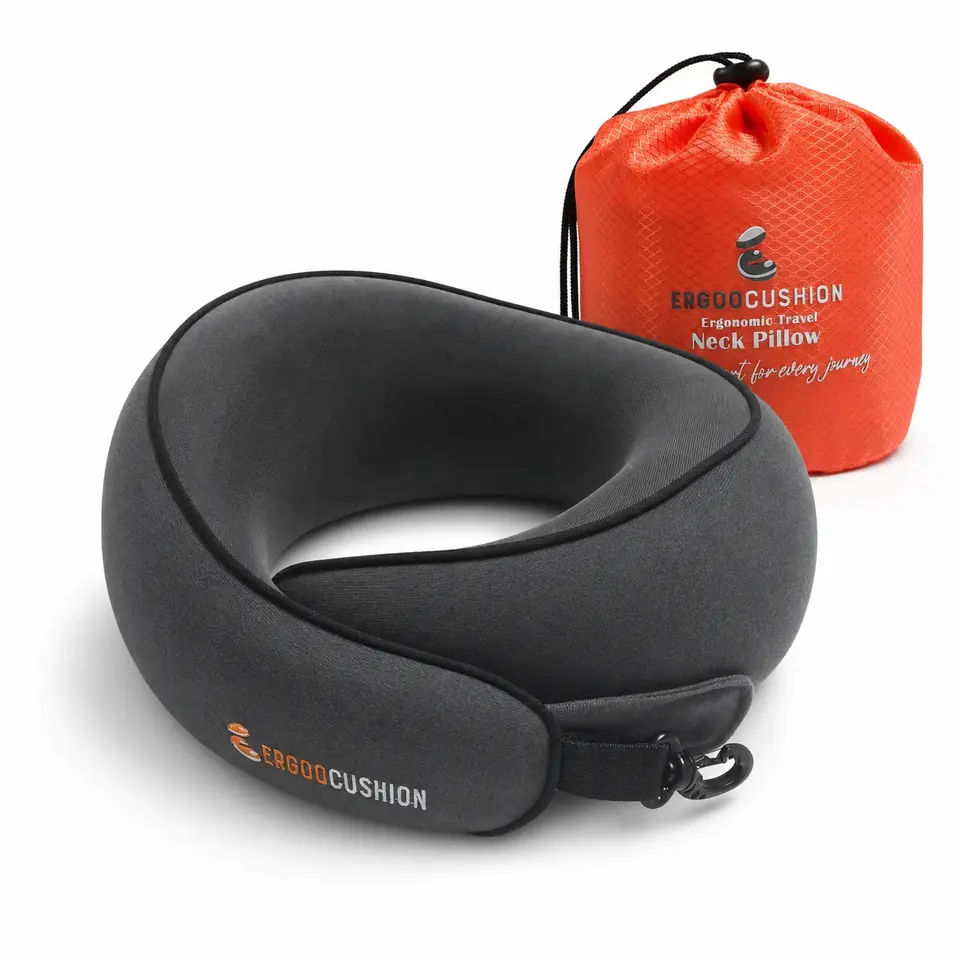
This guide compares general travel-seat-cushion designs. ERGOOCUSHION sells an inflatable seat cushion and a memory foam neck pillow. The neck pillow is not a foam seat cushion and is not the foam alternative in the comparison below. We have not conducted a controlled comfort or durability test between competing cushions.
Inflatable versus foam: a practical comparison
On a small screen, scroll the table sideways to compare both columns.
| Decision factor | Inflatable seat cushion | Foam seat cushion |
|---|---|---|
| Changing the feel | Add or release air to adjust the fill. | Feel is set mainly by the foam, shape and thickness; you do not adjust it through an air valve. |
| Getting ready | Needs inflation and a check that the valve is closed correctly. | Usually ready to place on the seat without inflation. |
| Packing | Can be deflated; the actual folded size depends on its construction and pouch. | May roll, fold or remain fairly bulky depending on the design. Check permitted compression. |
| Sitting height | Changes with fill and how the cushion compresses under you. | Depends on thickness, contour and compression under you. |
| Things to inspect | Valve operation, seams and whether it holds its intended fill. | Shape recovery, cover condition and whether the foam is damaged. |
| Cleaning | Follow the cushion and cover instructions for that model. | Follow separate instructions for the foam core and any removable cover. |
| Air travel | Check airline permission, seat fit and whether the feel needs adjustment. | Check airline permission and seat fit; a foam design does not remove those requirements. |
These are design considerations, not a ranking of every product. A compact foam cushion may suit your bag better than a large inflatable model. A well-matched air cushion may suit your preferences better than a foam shape that lifts you too high. Judge the finished product, not the label alone.
Adjustable air does not mean “inflate as much as possible”
The main practical advantage of an inflatable cushion is the ability to change its fill. That can be useful when you alternate between a harder chair, a padded travel seat and a seat of a different height. You can try a softer or firmer feel without buying a different foam grade.
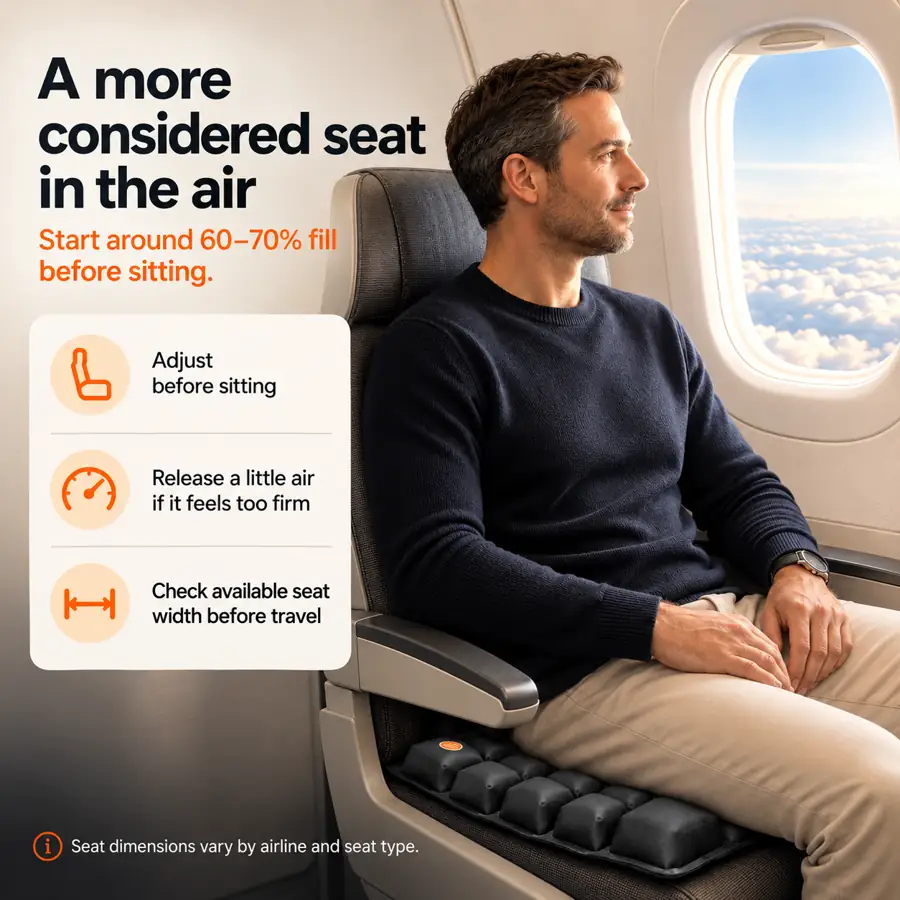
The ERGOOCUSHION guide suggests an initial fill of approximately 60–70%, followed by adjustment. Less air gives a softer feel and a lower sitting position; more gives a firmer feel and a higher position. Start from that suggestion and make small changes. A cushion that feels good when squeezed by hand may feel different when you sit on it.
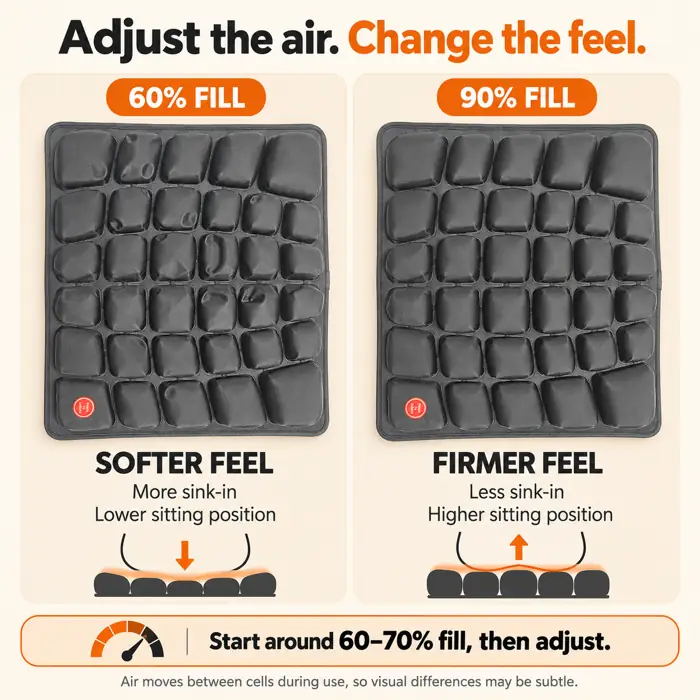
If you do not want to pump, check valves or adjust air during travel, that same flexibility may be a task you would rather avoid. In that case, a suitable foam design can be the simpler choice.
Foam density and firmness are different properties
Foam cushions are not all made to feel the same. The Polyurethane Foam Association distinguishes density—the material’s mass per unit volume—from firmness, which describes its surface feel under indentation. A higher-density foam is not necessarily firmer. Shape, thickness and the foam specification also matter when assessing a cushion. [1]
Memory foam is a particular type of flexible foam with slow recovery after compression. PFA’s technical bulletin notes that its firmness and recovery can vary with temperature and humidity. That explains why the words “memory foam” alone do not establish a fixed feel in every environment or prove that one cushion is superior. [2]
For a purchase decision, look for usable information: the foam type, actual dimensions, cover construction and care instructions. If a seller publishes tested firmness or density, use it as part of the specification rather than translating it into an automatic comfort score.
Compare packed size, not just the product photograph
Decide where the cushion will go when you are not sitting on it. An occasional flight with room in a suitcase creates a different packing problem from a trip where everything must fit inside one small bag. Measure the space you can spare before deciding how much cushion you want.
For an inflatable model, ask for both the inflated cushion dimensions and the packed measurements. For foam, check whether the manufacturer permits folding or rolling, and how the cushion should be stored after compression. Do not assume that every foam cushion can be vacuum-packed or forced into the smallest possible pouch.
The ERGOOCUSHION inflatable model includes an orange carry bag shown at approximately 9 × 11 inches (23 × 28 cm). That is the bag measurement, not a complete three-dimensional packed-volume specification and not the inflated sitting area. Use the current listing for the cushion’s full dimensions. We do not publish a verified product weight here, so a claim that it is lighter than a particular foam model would require additional specifications.
Fit can matter more than the material
Compare width and depth with the seat’s usable area. Then consider what happens when you sit on the cushion. Added height may change how the armrests, backrest or tray feel. The outline of a cushion also matters: a contoured product intended for one chair may not suit a different seat.
Try the candidate in the position you will actually use. Notice whether it stays within your seat, whether you can sit back comfortably, and whether you feel stable when shifting slightly. If the cushion is too large, too high or uncomfortable, a different fill or material name will not necessarily solve the fit problem.
For flights, check the operating airline’s policy and follow cabin-crew instructions. Neither foam nor air provides a blanket permission to change the seat arrangement. Our airplane seat-cushion guide explains the distinction between a cushion, footrest and bed extender, plus seat-belt and inflation checks.
Match the cushion to three common travel routines
You change seats throughout the journey
If you move between a train, airport seating and your destination’s chairs, adjustable air gives you a way to experiment with fill. Choose it when that adjustment is useful to you and you are willing to inflate and repack it.
You want the least setup at each stop
If you mainly use one familiar seat and prefer to put a cushion down and sit, a suitable foam shape may be more convenient. Check that its fixed dimensions and packed size work for the whole journey, not just the first seat.
Your bag is already close to its limit
Compare the actual packed products with the remaining space and permitted baggage weight. Deflation is useful, but a size or weight decision needs measurements. A pouch that looks small in a photograph is not a substitute for a full specification.
Check care and maintenance before buying
For an air cushion, read how the manufacturer expects you to use the valve, protect the cushion during transport and clean its surfaces. For foam, check whether the cover is removable and whether the core has a different cleaning method. Machine-washable fabric does not automatically mean the complete cushion can go into a washing machine.
Inspect a new purchase before the trip rather than learning its setup at the departure gate. Confirm that an inflatable model holds the intended fill and that a foam model recovers to its intended shape. Follow the specific instructions if something appears wrong and use the support channel for the order. The material alone does not establish a guaranteed service life.
Questions that often decide the purchase
Which type is best for a long flight?
There is no universal winner. Choose by permitted use, seat fit, your preferred feel and the setup or packing routine you are willing to manage. A long-flight label is not evidence that a cushion will suit every traveler.
Is foam always firmer than air?
No. Foam can be made in different firmness levels, while an air cushion changes with fill and construction. Compare the actual models rather than assuming firmness from the material category.
Will either type treat back or tailbone pain?
This guide addresses general comfort, not medical treatment. If you require a cushion for a medical condition, obtain advice appropriate to that need instead of choosing from travel-marketing claims.
Can I use a travel neck pillow as the foam comparison?
A neck pillow and a seat cushion support different areas of the body. Compare seat cushions with seat cushions. Our neck-pillow wearing and packing guide explains the separate seated-rest use case.
Choose the trade-off you actually prefer
An inflatable cushion is worth considering when you value adjustable fill and deflated packing. Foam is worth considering when a fixed shape and little setup better match your routine. Before ordering either, confirm the dimensions, packed arrangement, care method and intended seat fit.
If the adjustable option matches your needs, explore the ERGOOCUSHION inflatable seat cushion and its demonstration videos. For retail purchases, use the product page’s Amazon link to check current specifications, price and order terms.
Sources and comparison limits
[1] Polyurethane Foam Association: Foam Performance. Reference for density, firmness and variation in foam properties.
[2] PFA: IN•TOUCH, Volume 11, Number 1, viscoelastic foam (PDF). Reference for memory-foam recovery and environmental sensitivity.
The air-cushion details and illustrations are from ERGOOCUSHION’s supplied guides on its product page. This is a specification-based buying guide, not a comparative laboratory test. It does not establish clinical outcomes, a durability ranking or the superiority of ERGOOCUSHION over named competitors. Sources checked on 12 October 2026.